

CITIES AS TECHNOLOGICAL KATECHON
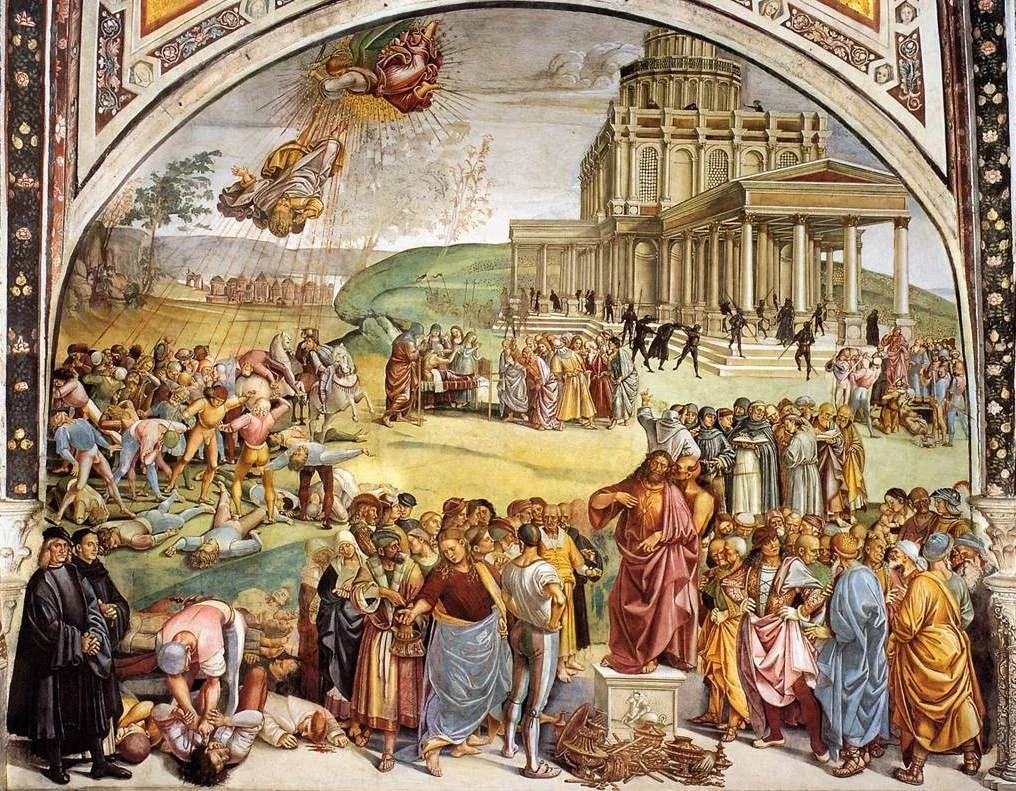
The Preaching of the Antichrist (Italian: La predicazione dell'Anticristo) fresco by the Italian Renaissance painter Luca Signorelli.
Peter Thiel’s recent Anti-Christ lecture at the University of Cambridge revived an unfashionable but necessary question.
What restrains civilisations from collapse? What holds entropy at bay long enough for renewal to occur? Drawing on the ancient theological concept of the katechon, Thiel suggested that technological progress, particularly within a multipolar world, functions as the West’s restraining force and protection against collapse and the rise of an Anti-Christ figure.
The argument deserves to be taken seriously.
Civilisations decay not simply because they are defeated, although that certainly happens (Thucydides), but because they become inert. Decision cycles lengthen. Risk aversion replaces experimentation. Institutional complexity accumulates faster than productive capacity. Energy systems tighten. Industrial capability thins. Strategic confidence softens. Entropy expresses itself in bureaucracy before it expresses itself in battle.
Technological progress interrupts that pattern.
It expands optionality. It increases productivity. It multiplies leverage. It restores agency. In a multipolar world, where rivals innovate and compete openly, complacency becomes expensive. Competition forces renewal. Progress becomes restraint.
If technological acceleration is the katechon, then the question becomes: where does that acceleration originate?
Historically, it originates in cities.
Cities are metabolic machines. They compound talent, capital, infrastructure, and ambition into productive friction. Breakthroughs rarely emerge from dispersed isolation. They emerge from clustered intensity. The industrial revolution was urban. The age of steam, the age of electricity, the age of finance, the age of computing, the golden age of cinema — each advanced through cities capable of metabolising human genius into cultural and technological power.
To weaken cities physically, to restrict their ability to build, to overburden their infrastructure, to paralyse their regulatory systems, is therefore to weaken the very mechanism through which technological progress restrains decline.
We’re already seeing it.
When housing cannot expand, talent stagnates.
When energy approvals stall, industry relocates.
When infrastructure costs double relative to peers, capital withdraws.
When regulatory timelines stretch from months to years, experimentation dies. Each constraint compounds the next. A system designed to preserve stability becomes a machine that suppresses dynamism.
The decay is also spiritual.
Sclerosis in the West does not only choke projects. It chokes aspiration. For successive generations, our young people have been socialised into caution rather than courage. They are taught to optimise credentials rather than to build. They are encouraged to curate identities rather than to construct institutions. They inherit systems that are administratively dense yet mission-light.
Ambition narrows.
Risk tolerance declines.
Imagination contracts.
Confidence erodes. Quietly.
When a civilisation ceases to offer new frontier opportunities, it begins to produce fraudulent aesthetic competitions instead of risky productive achievement. Status replaces substance. Signalling replaces building. The energy that once fuelled expansion is redirected into performance.
Unfortunately, technological stagnation and spiritual stagnation reinforce one another at an ever-increasing pace.
Thiel’s insight that multipolarity itself functions as part of the katechon is crucial here. When rival powers advance industrial capacity, launch infrastructure, and advanced manufacturing at speed, the West cannot afford paralysis. Competition disciplines complacency. It clarifies stakes.
Yet, multipolarity alone does not generate renewal. It rather usefully exposes weakness.
REBUILDING THE KATECHON
The West now requires physical spaces where technological acceleration is not administratively suffocated. It requires cities designed to metabolise ambition at speed (again). It requires regulatory regimes optimised for throughput rather than feelings. It requires energy dominance, industrial integration, and strategic clarity.
In short, the West’s katechon is impotent without frontier cities.
Frontier cities operate under a simple principle: results = survival .
They must attract talent, or they’ll die.
They must build quickly, or they’ll die.
They must integrate infrastructure efficiently, or they’ll die.
They cannot afford to indulge in luxury belief or rely on inherited scale or bureaucratic inertia.
Our young people require more than comfort. They require purpose. Throughout history, frontiers have supplied this. The American West drew engineers, surveyors, miners, and builders into projects larger than themselves. Hong Kong attracted young professionals who could assume responsibility at twenty-five that would have taken decades elsewhere. Industrial port cities offered mobility not only of goods but of destiny.
Frontiers reallocate ambition from introspection to construction.
A frontier city dedicated to advanced energy, aerospace manufacturing, AI infrastructure, and space industrialisation wouldn’t just strengthen civilisational capacity. It would offer a mission, demand competence and reward courage.
It would channel youthful restlessness into tangible, verifiable progress.
The katechon, in this reading, is physical, catalytic and productive.
Our current multipolarity will not wait for the West to resolve its procedural anxieties. If technological progress restrains decline, then hesitation invites it.
The Western katechon of the twenty-first century will not be a sermon or a symbol. It will be a network of cities capable of converting talent into power at scale.
The deeper question is whether the West still believes that such conversion is both necessary and possible.
If it does, it must build accordingly.
