

BUILDING THE INTERPLANETARY ECONOMY.
Why An Interplanetary Economy Doesn't Work Without VERTICALLY INTEGRATED Spaceport Cities (VISCs).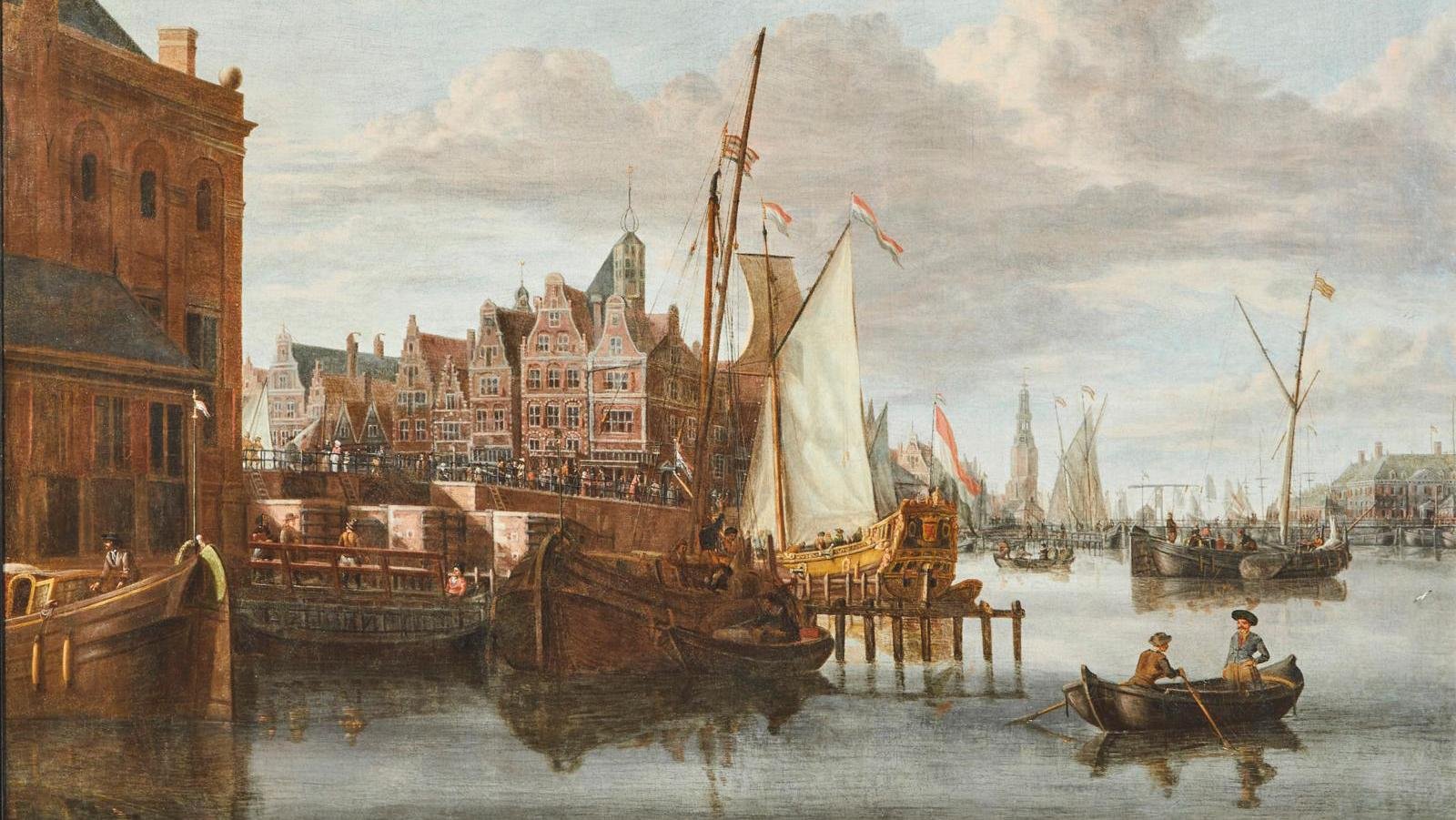
At its height, Amsterdam handled an estimated 40% of Europe’s maritime trade.
Storck (1641-c. 1692), View of Amsterdam Port: The Ij Near the New Bridge, oil on canvas.
The interplanetary economy is already coming into view. Launch costs are falling. Orbital infrastructure is proliferating. Manufacturing in microgravity, space-based energy systems, and off-world resource utilisation are no longer speculative ideas but line items in serious corporate and national strategies. The question is no longer whether economic activity will extend beyond Earth, but how that activity becomes economically real.
History suggests a clear answer. Economies do not mature through technology alone. They mature through institutions, and institutions concentrate in cities.
The decisive challenge of the coming decades is therefore not simply building rockets or factories in orbit. It is building the urban gateways through which the interplanetary economy will be governed, financed, insured, regulated, and integrated into terrestrial markets. Without such gateways, space activity remains infrastructure without an economy.
Gateway Cities and the Making of Trade
Throughout history, the cities that mattered most were rarely those that merely produced goods. They were the cities that sat at thresholds. Seaport cities did not become wealthy because ships arrived there, but because they mediated between jurisdictions, currencies, legal systems, and sovereign power. They transformed movement into commerce, and commerce into state capacity.
Customs houses were central to this process. They were not administrative afterthoughts, but institutional engines. It was at customs that goods were inspected, valued, taxed, insured, and legally recognised. This act of recognition converted physical cargo into economic reality.
The interplanetary economy will require the same conversion.
From Exploration to Industrial Space
Space is rapidly shifting from an exploratory domain to an industrial one. Satellites already underpin global communications, navigation, finance, and intelligence. Orbital manufacturing promises materials and processes impossible on Earth. Lunar and near-Earth resource utilisation appears increasingly in strategic planning documents. Space-based energy systems are being actively tested.
What is emerging is not a detached “space economy”, but an off-world extension of the terrestrial economy, linked through launch, data, energy, materials, and capital. These flows must land somewhere. They must be cleared, regulated, insured, financed, and legally recognised.
That work will not happen in vacuum. It will happen where institutions already cluster: in cities.
VERTICALLY INTEGRATED Spaceport Cities as Economic Interfaces
Vertically integrated spaceport cities should be understood not as launch facilities, but as interfaces between two economic systems: the Earth-bound economy and the off-world economy. They are the places where launch and landing infrastructure is deliberately co-located with manufacturing, finance, law, governance, and data systems.
Their function is to collapse distance. Distance between design and deployment. Between production and market. Between off-world activity and terrestrial recognition. This is precisely what successful frontier cities have always done.
As space industrialisation accelerates, these cities will also assume a role that is both ancient and unavoidable: they will become the customs gateways of the interplanetary economy. Components manufactured in orbit, materials returned from the Moon or asteroids, and data products generated beyond Earth will require clearance, valuation, liability assignment, and regulatory recognition before they can circulate within terrestrial markets. These processes will concentrate where launch, landing, finance, law, and logistics meet.
In this sense, industrial spaceport cities are not merely points of departure. They are institutional chokepoints through which interplanetary trade must pass.
What History Tells Us About Customs and Power
History is unequivocal on the importance of such chokepoints.
London’s Custom House, established in the thirteenth century and expanded alongside England’s maritime rise, sat at the fiscal core of the British state. By the late eighteenth century, customs and excise accounted for roughly one-third to one-half of total government revenue, much of it flowing through the Port of London. This revenue underwrote Britain’s creditworthiness, its navy, and its global reach.
Amsterdam offers an even starker example. In the seventeenth century, the Dutch Republic derived its power not from territorial scale, but from intermediation. Amsterdam’s port, bourse, and customs regime enabled goods from the Baltic, the Americas, and Asia to be cleared, financed, insured, and redistributed at scale. At its height, the city handled an estimated 40 percent of Europe’s maritime trade, converting trade throughput into geopolitical leverage.
For the modern West, however, the most instructive precedent is Hong Kong. Operating as a free port with exceptionally fast customs clearance, transparent commercial law, and deep financial markets, Hong Kong became the principal gateway between China and the global economy. In the decades before and after the 1997 handover, it routinely processed trade flows valued at multiple times its own GDP. It functioned less as a producer than as an institutional hinge.
Crucially, Hong Kong’s legal and customs architecture was legible and trusted by Western capital. British common law, predictable regulation, and efficient clearance allowed capital to enter China and manufactured goods to leave it with minimal friction. This gateway role was decisive. It enabled cities such as Shenzhen to scale at extraordinary speed while remaining intelligible, investable, and insurable within global markets. Long after Britain’s direct political control waned, the institutional design of Hong Kong continued to project Western commercial influence deep into the Asian industrial system.
In every case, the city that controlled the customs gateway did not merely process trade. It set standards, captured value, and anchored sovereignty.
Why Space Needs Cities, Not Just Platforms
It is sometimes suggested that interplanetary commerce could be handled primarily in orbit, through platforms, stations, or automated systems. History suggests otherwise. Trade without institutions is not trade; it is movement.
Customs requires courts, regulators, insurers, auditors, financiers, data infrastructure, and human judgement. These functions cluster spatially. They require dense professional ecosystems and stable governance. They require cities.
Industrial spaceport cities will therefore play the same role for the interplanetary economy that maritime cities once played for global trade. They will be where off-world activity becomes legally recognised economic value on Earth.
Conclusion: A Narrow Window, and No Second Chances
The interplanetary economy will not be shaped by whoever launches first, nor by whoever builds the most impressive hardware in orbit. It will be shaped by whoever controls the chokepoints where off-world activity becomes economic reality: where value is recognised, cleared, insured, regulated, financed, and allowed to circulate.
History is unforgiving on this point. Civilisations that controlled maritime customs gateways controlled global trade. Those that did not became suppliers, dependencies, or spectators. The same logic now applies beyond Earth.
The West still possesses an extraordinary advantage: deep capital markets, trusted legal systems, sophisticated insurance and finance, and cities capable of hosting dense institutional ecosystems. But this advantage is not permanent. It must be deliberately anchored to the new frontier. If industrial spaceport cities are not built to serve as the gateways of the interplanetary economy, those gateways will emerge elsewhere, under different rules, standards, and interests.
There will not be multiple chances to get this right. Once trade routes harden, once standards are set, once customs regimes and institutional norms are embedded, power locks in for generations. The cities that clear interplanetary trade will define who captures its value, who sets its terms, and who ultimately governs its expansion.
The interplanetary economy will exist. The only open question is whether the West chooses to control its most lucrative and strategically essential chokepoints — or allows them to be captured by others. History suggests that civilisations rarely lose such moments through defeat. More often, they lose them through hesitation.
Romullus won’t allow this to happen.
It’s now or never.
