

INDUSTRIAL SPACEPORT CITIES.
How We Revive the West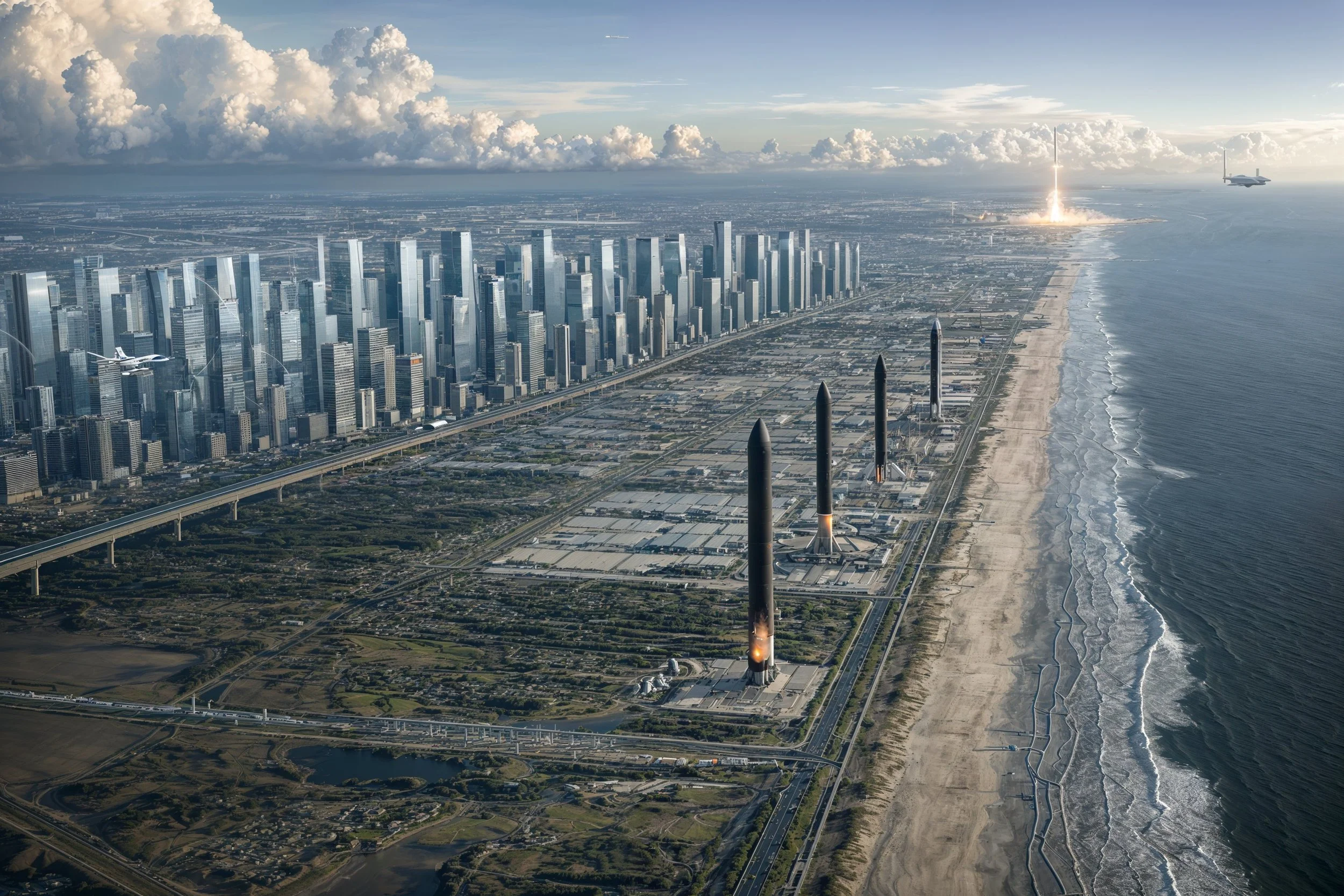
Every major shift in economic power has followed the same underlying pattern: cities rise not merely because they produce, but because they mediate between worlds. The next such threshold is no longer maritime. It is planetary.
The West’s problem is no longer a lack of ideas. It is the far more dangerous condition of having made itself hostile to the birth, scaling, and protection of new industrial systems. Breakthroughs still occur in universities, laboratories, and startups, but too often they are later suffocated by the four horsemen of stagnation: a fearful civic culture, over-regulation, NIMBYism, and capital that has become structurally averse to risk.
This is not how successful civilisations behave at moments of technological inflection. When new industrial epochs emerge, the winners do not merely subsidise innovation. They build the places where innovation can be industrialised, financed, exported, defended, and compounded. The history of economic power is, in no small part, the history of cities deliberately designed for new frontiers.
Today, that frontier is no longer maritime. It is planetary.
The central claim of this essay is simple: the West will not revive itself without building a new class of cities. These cities will be Western equivalents of Shenzhen and Pudong, but oriented toward AI, autonomous manufacturing, aerospace, and the industrialisation of space. They will sit at the crossroads between the Earth-bound economy and the off-world economy, just as the great seaport cities once sat between the Old World and the New.
I. Gateway Cities and Civilisational Power
Throughout history, the most powerful cities have rarely been those that merely produced goods. They were the cities that mediated between worlds. In the early modern era, seaport cities became wealthy not because ships docked there, but because they controlled the interface between continents, currencies, legal systems, and sovereign authority. They compressed distance, reduced uncertainty, and turned geography into compounding advantage.
This pattern is remarkably consistent. Whether Venice, Amsterdam, London, or later Hong Kong, the decisive cities were those that sat at economic thresholds. They were gateways.
The emerging frontier is not across an ocean, but above the atmosphere. As space transitions from an exploratory domain to an industrial one, the decisive question becomes not who launches first, but which cities control the interface between planetary and off-world production.
II. What the Late-Twentieth-Century Frontier Cities Actually Did
The most instructive modern examples are the Chinese reform cities that emerged from the late 1970s onward. Shenzhen and Pudong are often described as manufacturing hubs or financial districts. This understates their real function. They were frontier interfaces, designed to collapse distance between decision, production, and exchange.
Shenzhen evolved into an execution engine for hardware-intensive industry, with dense supplier networks, rapid iteration cycles, and extraordinary export capacity. By 2023, it produced roughly $480–500 billion in GDP and handled over $540 billion in trade, with nearly three-quarters of exports in mechanical and electrical products. Pudong, meanwhile, became a financial and institutional gateway, anchoring Shanghai’s role as a global trade and capital node, with regional GDP in the mid-$200-billion range and a concentration of multinational headquarters and research centres disproportionate to its land area.
The lesson is not ideological. These cities worked because they were built to make new industries inevitable, not merely possible. They aligned rules, infrastructure, capital, labour, and throughput in one geography. Speed, not subsidy, was the true advantage.
III. Why the West Now Strangles Its Own Frontiers
The West’s failure today is not an inability to absorb new technology, but an environment in which new technology struggles to be born at scale, and is later constrained once it appears. Regulatory accumulation turns every decision into attritional process. Planning systems treat construction as an externality rather than a strategic act. Civic culture increasingly equates risk with irresponsibility. Capital, conditioned by decades of financialisation, prefers regulated yield to frontier compounding.
The result is a distinctive Western pathology: innovation without industrialisation. Ideas emerge, then migrate, stall, or are absorbed elsewhere. The civilisation retains its rhetoric of progress while losing the capacity to build.
History offers no examples of civilisations that escaped this condition without deliberately creating new environments where frontier activity was protected from the inertia of the core.
IV. The New Industrial Domains
The next frontier differs fundamentally from those of the twentieth century. The dominant domains now emerging are:
Artificial intelligence, as a general technology of production and coordination.
Autonomous manufacturing, particularly in aerospace and high-precision systems.
Space industrialisation, encompassing launch, in-orbit manufacturing, energy generation, and off-world resource utilisation.
Climate resilience, as a prerequisite for sustained urban productivity and population stability.
These domains demand cities that are designed, from inception, to support high energy density, rapid iteration, complex logistics, and long-term human performance. Retrofitting legacy cities can deliver incremental gains, but it cannot reliably produce the environments in which entirely new industrial systems are born.
IV. The New Frontier: The Earth–Off-World Economic Interface
Every major shift in economic power has followed the same underlying pattern: cities rise not merely because they produce, but because they mediate between worlds. The great seaport cities of the past were not wealthy because ships docked there, but because they sat at the junction where goods, capital, law, and sovereignty converged. They were the places where value crossed thresholds and was made legible to the state.
The next such threshold is no longer maritime. It is planetary.
As launch costs fall and orbital capability expands, space is rapidly ceasing to be an exploratory domain and becoming an industrial one. Satellites are already indispensable economic infrastructure. Orbital manufacturing, in-space assembly, and space-based energy systems are moving from theory into early execution. Lunar and near-Earth resource utilisation is now embedded in serious national planning. What is emerging is not a separate “space economy”, but an off-world extension of the terrestrial economy, tightly coupled to it through data, energy, materials, and logistics.
In this context, industrial spaceport cities are best understood as the interface between two economic systems: the Earth-bound economy and the off-world economy. They are the places where launch, landing, manufacturing, finance, and governance are deliberately co-located so that distance, delay, and uncertainty are minimised. Just as earlier frontier cities collapsed the distance between capital and production, these cities will collapse the distance between planetary production and terrestrial markets.
As space industrialisation accelerates, these cities will also assume a role that is both ancient and unavoidable: they will become the customs gateways of the transplanetary economy. Just as maritime cities housed customs houses where goods were inspected, taxed, insured, and legally recognised as they crossed between jurisdictions, industrial spaceport cities will sit at the point where off-world production re-enters terrestrial markets. Components manufactured in orbit, materials returned from the Moon or asteroids, and data products generated beyond Earth will require clearance, valuation, liability assignment, and regulatory recognition. Those processes will not occur in vacuum or purely in orbit; they will concentrate where launch, landing, finance, law, and logistics already meet. In this sense, spaceport cities are not merely launch sites, but the institutional chokepoints through which interplanetary trade will flow.
History is unambiguous on the power of such chokepoints. London’s Custom House, established in the thirteenth century and expanded as England became a maritime power, sat at the fiscal core of the British state. By the late eighteenth century, customs and excise provided roughly one-third to one-half of government revenue, underwriting Britain’s credit and naval dominance. Amsterdam’s port and customs regime allowed it, at its seventeenth-century peak, to handle an estimated 40 percent of Europe’s maritime trade, converting intermediation into geopolitical leverage.
For the modern West, the most instructive precedent is Hong Kong. Operating as a free port with rapid customs clearance, transparent commercial law, and deep financial markets, Hong Kong became the principal gateway between China and the global economy. In the decades surrounding the 1997 handover, it routinely processed trade flows worth multiple times its own GDP, functioning less as a producer than as an institutional hinge. British common law, predictable regulation, and efficient customs allowed capital to enter China and manufactured goods to exit with minimal friction. This gateway role was decisive. It enabled cities such as Shenzhen to scale at extraordinary speed while remaining intelligible and investable to Western capital, extending Western commercial influence long after formal political control had ended.
In every case, the city that controlled the customs gateway did not merely process trade; it set standards, captured value, and anchored sovereignty. Industrial spaceport cities will inherit this role at a planetary scale. The customs houses of the future will sit beside launch pads and downlink nodes, translating off-world production into legally recognised, insured, and taxable terrestrial value.
V. Western Industrial Spaceport Cities
The West must therefore build its own equivalents of Shenzhen and Pudong, redesigned for the twenty-first-century frontier. These cities will be explicitly oriented toward AI, autonomous manufacturing, aerospace, and space logistics. Some will function primarily as execution engines, clustering autonomous factories, robotics suppliers, and aerospace systems. Others will act as orchestration hubs, concentrating finance, legal infrastructure, data governance, and institutional credibility.
Critically, they will be positioned not as peripheral science projects, but as primary gateways of trade, capital, and sovereignty between Earth and off-world industry.
VI. A Hybrid Model for the Next Frontier

Nothing will compete with raising a family on the frontier.
The emerging model can be understood as a deliberate synthesis:
Hong Kong, for global capital aggregation, legal clarity, and trust.
Shenzhen, for manufacturing velocity and dense industrial clustering.
Starbase, for aerospace cadence, engineering-led execution, and proximity between design, test, and deployment.
Copenhagen, for climate resilience, urban health, and long-term human performance.
This final element is not aesthetic. Cities that exhaust their populations do not win long games. The lessons of Urban Healthonomics are economically decisive: health, walkability, thermal efficiency, and liveability function as productivity infrastructure. Frontier cities must be places where families choose to live, not merely where projects are executed.
VII. Why Retrofitting Is Not Enough
Upgrading existing cities is necessary, but insufficient. Legacy planning regimes, land fragmentation, and regulatory inertia impose hard limits on what can be achieved through retrofit alone. History again is instructive. Britain modernised London and Manchester, but also built Hong Kong. The United States upgraded New York, but founded Chicago and later the Sun Belt cities. Every civilisation that successfully navigated a new industrial era did both.
Conclusion: Building Our Way Out of Stagnation
The West will not revive itself through declarations, incentives, think-tanks, or nostalgia. It will revive itself the way leading civilisations always have: by building and controlling new gateways to the next world.
Industrial spaceport cities are not utopian experiments. They are the institutional response to a civilisation that has allowed fear, regulation, and rent-seeking to replace confidence and construction. They make visible again what progress looks like: cranes, factories, laboratories, launch infrastructure, and families moving toward opportunity.
The alternative is not stability. It is managed decline.
History is unsentimental about societies that refuse to create the environments in which new eras are born. If the West wishes to remain prosperous, sovereign, and relevant in the century ahead, it must recover the will to build cities that sit at the intersection of Earth and space, and to treat the industrialisation of space not as spectacle, but as the decisive commercial frontier of our time.
