

ELIZABETHAN FRONTIERISM.
Frontiers are free. Decline is expensive.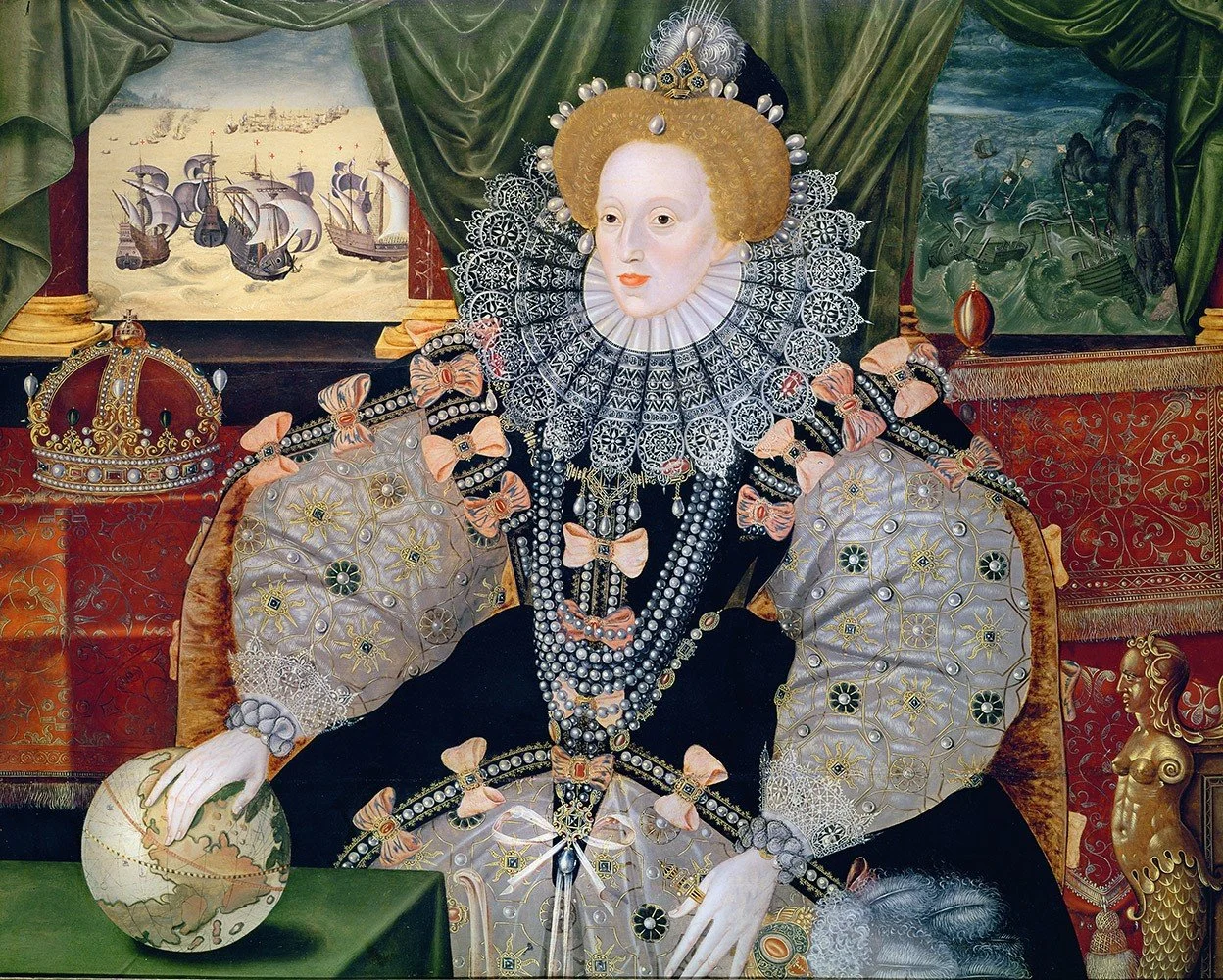
The Armada Portrait of Elizabeth I of England.In the background view on the left, English fireships drift towards the Spanish fleet, and on the right the Spanish ships are driven onto a rocky coast amid stormy seas by the "Protestant Wind".
Cardwell’s Law observes a recurring pattern in the history of technology: societies become most inventive in the early phases of their development, but as their institutions mature, they lose the capacity for radical innovation. Success ossifies into structure; structure becomes constraint; and constraint, if left unchallenged, hardens into stagnation. The question that haunts every civilization is therefore a simple one: how does a society escape the gravitational pull of its own success?
Civilizations escape stagnation only by opening new institutional frontiers—geographic, corporate, or technological.
Frontiers are the spaces where rules can be rewritten, where risk becomes productive rather than punitive, and where new organisational forms can emerge unencumbered by inherited constraints. They act as external shock absorbers against Cardwell’s Law, enabling the creation of fresh pathways for experimentation, capital formation, and technological advance. Across history, entrepreneurs operating through hybrid corporate–state structures have proven the most reliable frontier-makers: from the privateers of Elizabethan England to the deep-tech founders shaping today’s industrial and orbital landscapes.
Remarkably, only two nations in the last three centuries have successfully broken the Cardwellian cycle of innovation, stagnation, and decline by building new frontiers at a civilizational scale: Britain and China.
Britain (England), beginning in the Elizabethan era, repeatedly circumvented Cardwell’s Law by constructing institutional frontiers outside the constraints of its maturing domestic system, that could be utilised by corporations. Letters of marque incentivised corporate maritime risk-taking and proto-capitalist competition; chartered companies fused private capital with public authority; coporate colonial settlements transmitted British legal and commercial norms across continents; and later, industrial clusters created self-reinforcing engines of innovation. The American “fork” ultimately became the most dynamic extension of Britain’s institutional DNA. Frontier-builders such as the East India Company, the railway syndicates, and the great Victorian industrialists not only multiplied Britain’s global reach but continually renewed its economic capacity—precisely by operating where domestic constraints did not apply.
China, after nearly a century of stagnation, also seem to have sidestepped Cardwell’s Law by building new institutional frontiers rather than attempting to repair an exhausted central bureaucracy. Deng Xiaoping’s four Special Economic Zone Cities functioned as urban laboratories of regulatory experimentation where entrepreneurial risk-taking was structurally rewarded. The transformation of Shenzhen from fishing village to advanced manufacturing and robotics hub, and the rise of firms such as DJI and BYD, demonstrate a deeper truth: civilizational renewal depends on institutional space, not political rhetoric. It requires zones where new economic logics can take root, evolve, and scale without being suffocated by incumbent systems.
Elizabethan Frontierism, therefore, offers a broader historical principle:
Civilisations do not escape Cardwell’s Law by only perfecting existing institutions, but by building new frontier institutions where the next chapter of the economy can be born.
This is why we’re reinforcing existing Western cities with an internet for physical AI and building new spaceport cities on our final frontier.
