

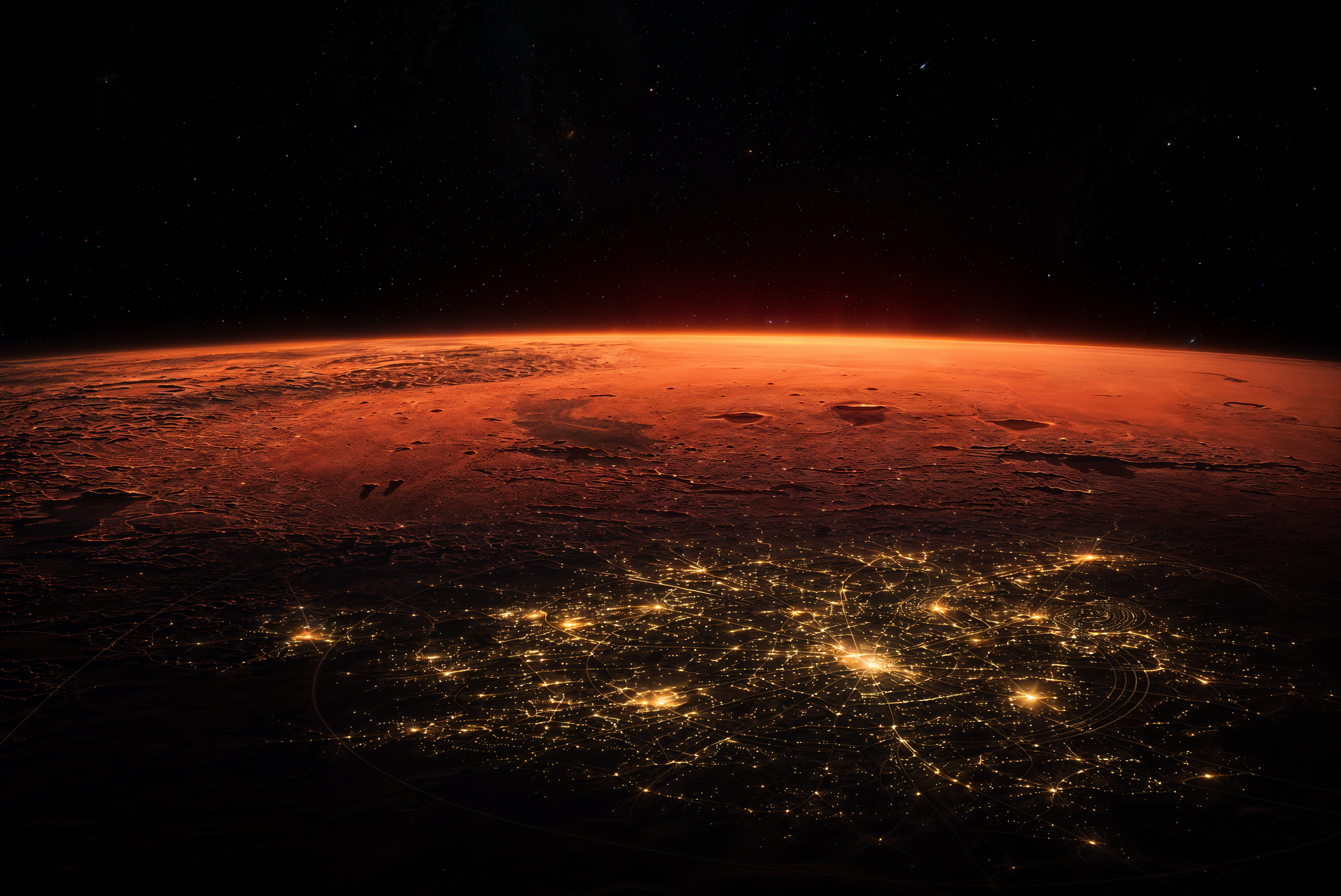
BUILDING THE VON NEUMANN PROBE COMPANY
THE SPACEPORT CITY PRIMESPACEPORT CITIES THAT BUILD SPACEPORT CITIES
The logical end state of the ROMULLUS mission to make the West multi-planetary through cities, before our adversaries, is to become an urban-industrial Von Neumann Probe Company.
A human settlement on Mars, or any other planet, will not begin as a human city. It will begin as a machine city. Machines will arrive first, as they already have. They will survey, grade, excavate, fabricate, assemble, inspect, power, repair, and replicate. They will then build the industrial foundation required to support human life before human beings arrive at scale.
Only then will the machines build the human city.
And once that city is able to sustain, repair, and reproduce the system that created it, the kit of parts is launched toward its next target.
We believe turning spaceport cities into a rapidly deployable, self-replicating infrastructure network is how the West can quickly collapse the time and cost of city-building, win the space race on Earth in the near term, and carry that advantage off-world in the long term.
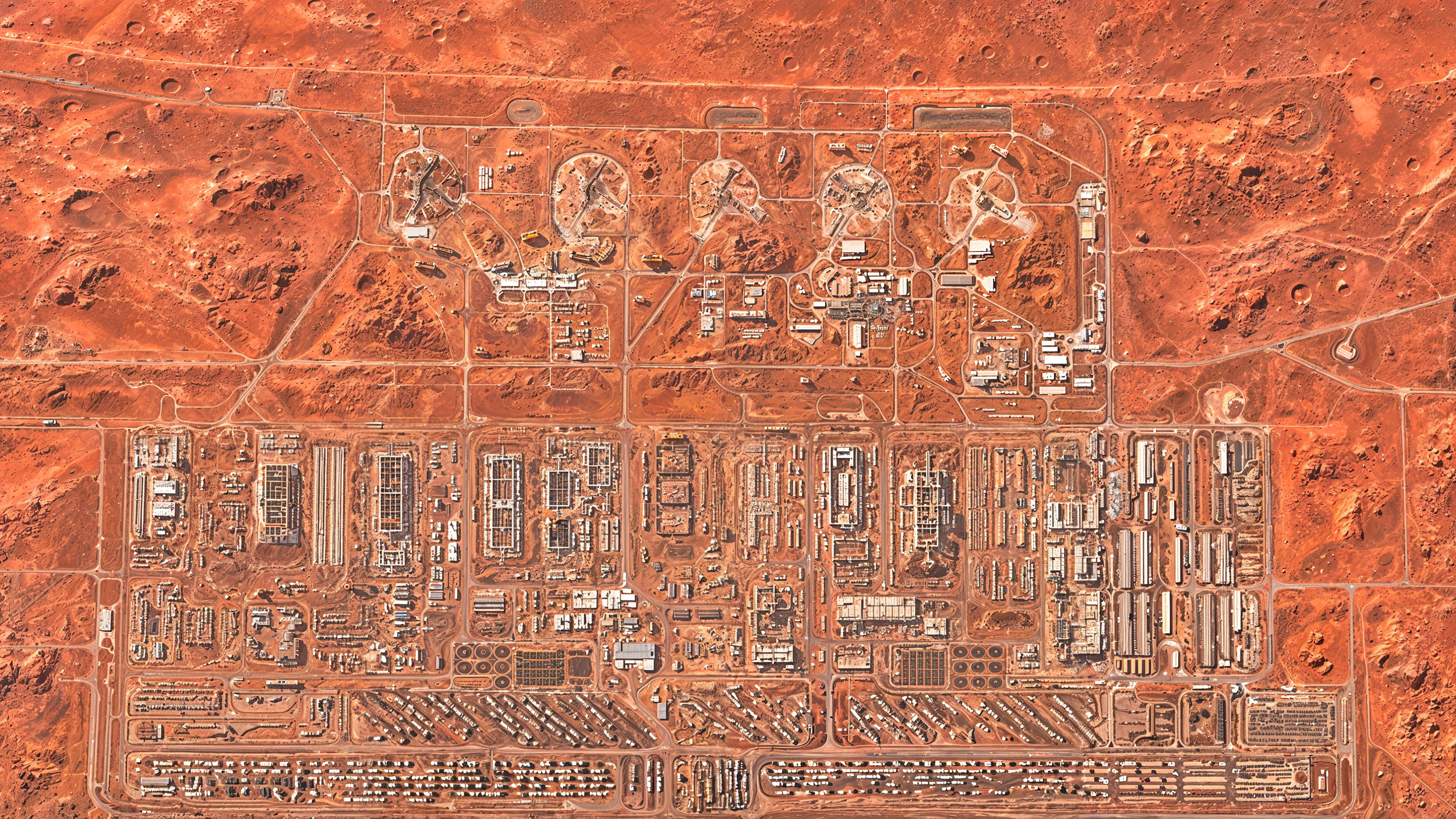
STEP 01: MACHINE OUTPOSTOUR ‘PROBE’ CONSTRUCTION FLEET LANDS AND BUILDS A MACHINE SPACEPORT CITY.
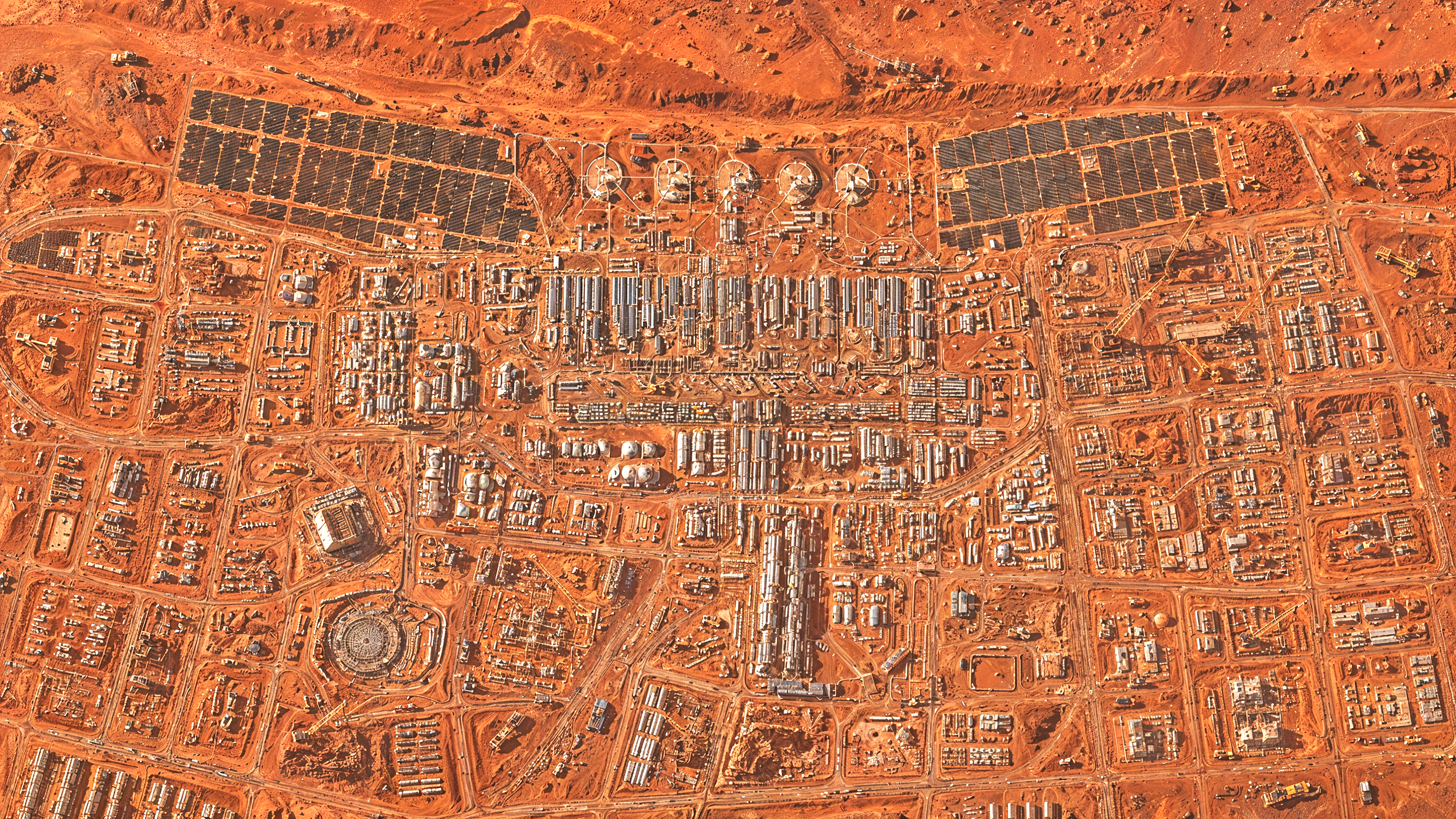
STEP 02: BUILD OUTThe Machine Spaceport City MANUFACTURES a SECOND probe fleet. The two fleets work together to construct the human spaceport city.

STEP 03: EXPONENTIAL EXPANSION ONCE THE MISSION IS ENDED, THE TWO PROBE FLEETS launch themselves TOWARD two new target locations.
RINSE, REPEAT.
FULL RATIONALE
ENGINEERING A COMPOUNDING LEADA von Neumann probe is a theoretical spacecraft capable of travelling to a new place, using local resources, building copies of itself, and sending those copies onward, exponentially.
The idea takes its name from John von Neumann, the mathematician who explored the logic of self-replicating machines. In science fiction, versions of this idea appear in many forms: the monoliths of 2001: A Space Odyssey, the self-replicating probes of the Bobiverse novels, and the wider tradition of machine explorers, seed ships, and autonomous industrial systems that spread through space ahead of human beings.
ROMULLUS takes this idea seriously, but we do not believe the first useful von Neumann probe will look like a small machine replicating itself amongst the stars.
We believe it will begin as a kit of parts for a machine spaceport city.
A human settlement on Mars will not begin as a human city. It will begin as a machine city. Machines will arrive first, as they already have. They will survey, grade, excavate, fabricate, assemble, inspect, power, repair, and replicate. They will then build the industrial foundation required to support human life before human beings arrive at scale.
Only then will the machines build the human city.
And once that city is able to sustain, repair, and reproduce the system that created it, the kit of parts is launched toward its next target.
That is the ROMULLUS interpretation of the von Neumann probe.
Not a single probe. Not a fantasy machine. A self-improving industrial spaceport city that builds self-improving industrial spaceport cities.
This is the logical culmination of our mission: to make the West multi-planetary through cities, before our adversaries.
The long road to a true and useful von Neumann probe begins on Earth.
It begins by building and replicating vertically integrated spaceport cities here, under real conditions, with real constraints, real regulators, real land, real weather, real materials, real supply chains, real machines, and real consequences.
This expertise cannot be scraped from the internet.
It cannot be simulated into existence.
It can only be earned by building.
Every FOUNDATION city is a training ground for physical AI. Every road, launch pad, energy system, factory, compute node, robot depot, logistics corridor, utility trench, inspection process, and construction sequence produces data.
Embodied data: the kind required to teach machines how to build in the physical world.
To build off-world cities, physical AI will need to understand ground conditions, tolerances, failure modes, sequencing, weather, materials, maintenance, machine coordination, human safety, and the thousand invisible judgements that determine whether a city works.
No one gets it by watching videos.
No one gets it from a lab.
It must be generated by building several real machine-first cities, deliberately, repeatedly, and at scale.
That is why ROMULLUS is not only building spaceport cities. We are building the process by which spaceport cities become autonomous to build.
The first city teaches the second. The second teaches the third. The third teaches the fourth. Over time, the construction process becomes more modular, more automated, more resilient, more legible to machines, and more suitable for off-world deployment.
The strategic importance of this becomes clearer once one understands the current legal and geopolitical structure of space.
No country can simply claim sovereignty over the Moon, Mars, or an asteroid by planting a flag. But in practice, the states and companies that can reach, operate, extract, protect, service, and industrialise useful locations first will shape the access routes, standards, resource flows, and operating norms of the space economy.
This makes rapidly deployable industrial presence decisive.
Space will not enrich humanity simply because it exists. It will enrich humanity if aligned civilisations build the infrastructure required to access it, use it, defend it, and distribute its benefits.
China has already understood the relationship between cities, infrastructure, speed, and strategic power. It has built a network of vertically integrated spaceport and industrial clusters that turn industrial capacity into planetary leverage.
This is a risk.
But it is also an opportunity.
Most existing Chinese spaceport clusters were not conceived as deliberate dry runs for building off-world cities and industrial systems. They emerged across very different strategic periods: Jiuquan in 1958, Taiyuan between 1966 and 1968, Xichang from 1970 to 1984, Wenchang from 2014 to 2016, Shandong/Haiyang from China’s first sea launch in 2019 into the Oriental Aerospace Port cluster, and Hainan’s commercial launch site from 2022 to 2024. They were built for national launch programmes, industrial policy, defence needs, sea-launch capacity, commercial launch capacity, and regional development. They are powerful, but they were not designed from first principles as iterative training grounds for autonomous city construction.
FOUNDATION is.
If we do our job correctly, the West gains an advantage that will compound slowly at first, then suddenly.
The edge will not be fully visible in the first city.
It will become visible in the fifth.
Then the tenth.
Then the first off-world industrial outpost will be built by our machines.
At that point, ROMULLUS will no longer be only a high-cadence strategic infrastructure company, or even a spaceport city company. It will have become something more important: a Von Neumann Probe Company.
A company capable of sending self-building industrial systems across the solar system to prepare outposts for human civilisation.
We will vertically integrate around this objective as much as is necessary. That means the nature of ROMULLUS may change over time. We ask for your patience because the company will look different at different stages of this journey.
Compute. Energy. Launch. Manufacturing. Robotics. Construction. Materials. Habitats. Water. Propellant. Security. Governance. Cities. More.
For us, the question is not whether humanity will become multi-planetary.
The question is whose systems, values, standards, institutions, and machines will shape that future first.
ROMULLUS exists to ensure the answer is ours.